In the Time Mapping exercise, you found out what activities you’re already putting your time towards, as a reflection your care and attention.
The arc of the workshop so far has been about connecting with your dreams and desires, seeing those play out in relation to your context, and finding out what priorities emerge through that interaction. Time is an important factor in that process, and we’re now revisiting time through the lens of prioritization.
When you get right down to it, there are always exactly 168 hours in a week. That’s refreshingly concrete!
You can slice it up precisely, you can vibe with it, you can slog or dance or race through your week—and no matter what, it still comes out to 168 hours.
When you’re prioritizing by time, there are two considerations. First, we’ll look at your Time Budget, and then we’ll look at how you’re using your time.
Time Budget
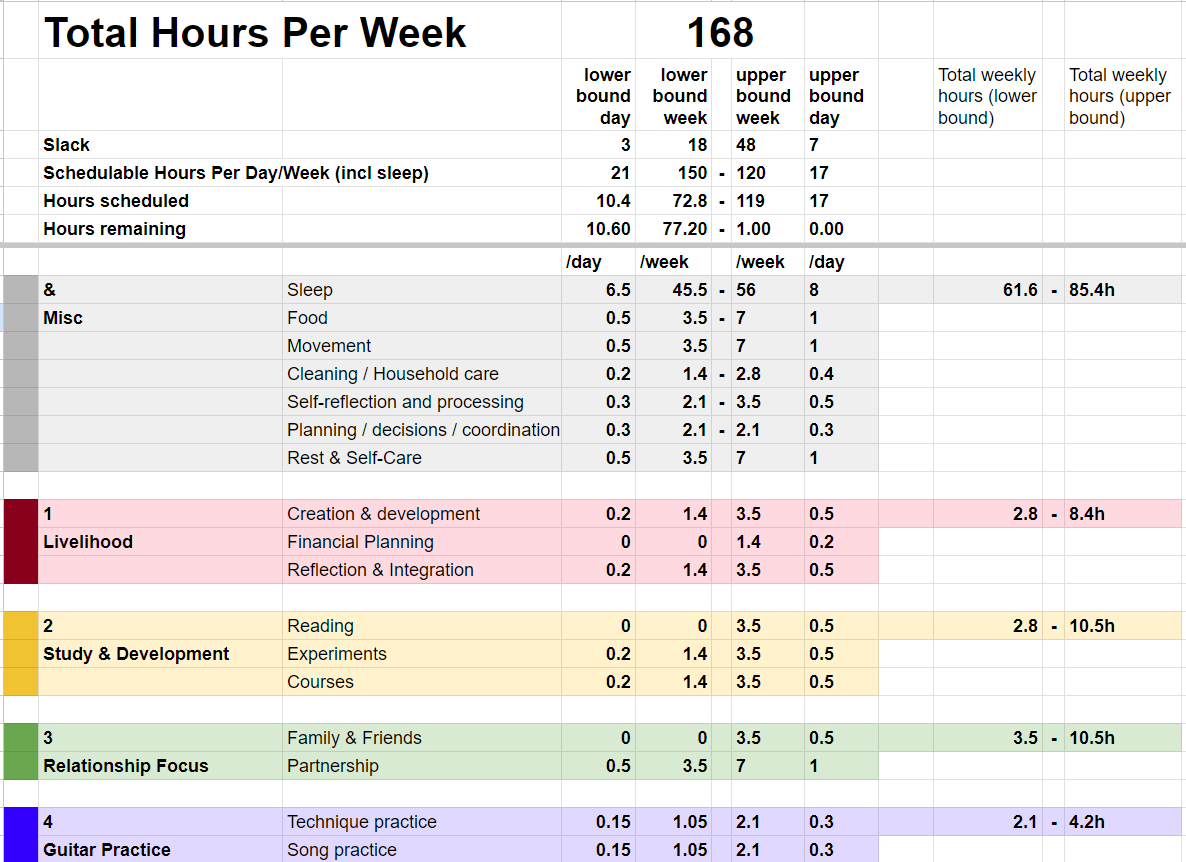
In this exercise, we’ll use a spreadsheet template to look at:
- How much of your time is already allocated? (For example: sleep, work, school…)
- How much time do you have to put towards various other intentions?
- How much time do you want to leave open and unstructured?
This technique works best for students or people with full-time or part-time jobs with regular hours, who can use it to figure out how much time they have left over for hobbies, side-hustles, and moonlighting, after accounting for their scheduled work time.
It may not be as useful if you tend to work more in sprints, where a whole week (or even a few days in a row) might regularly be intensely dedicated to one goal or project, such that you aren’t doing much of the other activities during that time.
Note that even if you’re working very intensely towards various goals, it’s still important to leave at least 10% of your time unscheduled, to build in some slack so that little unexpected delays can be absorbed gracefully rather than snowballing and derailing your whole day. When you have more flexibility, leaving 20-30% of your time unscheduled can make space for delightful emergent things you hadn’t even thought of.
It helps, also, to set a lower and upper bound for various activities.
Free up your Time
Now that you have a sense of how many hours per week you have available for various intentions, let’s see if there are any ways to work with that schedule so it flows better.
- Are there any activities from your Time Mapping that, on reflection, you straightforwardly want to stop doing?
- Are there periods of time (early in the morning, late at night, in between other activities) where you aren’t actually doing anything that feels very meaningful or enjoyable?
- Are there things that are important but that are clearly taking more time than they warrant?
- Are there ways you can save time by changing the timing or order in which you do things?
Make clear and reconsider unarticulated priorities and commitments.
- Revisit your list of all the priorities, commitments, obligations, intentions or goals that you are putting time towards.
- For each, ask yourself why is it intrinsically important to you that you are spending your time on this thing.
- Circle or highlight any that you don’t have a good answer for (including “I’m doing it because it is important to someone else”).
- For each, imagine a future scenario where you are no longer spending your time on the thing and there are no (or very limited) negative consequences. How was this possible?
- Take special note of instances where you would have to do something that might be uncomfortable in the short term but might free up your time and energy in the long term.
For each item, ask yourself the following questions:
- Activity / commitment discontinuation
- Can I just drop the thing?
- If not
- Might I be able to stop doing the thing in the future?
- Who do I need to speak with?
- What do I need to delegate?
- How do I need to plan in order to make this change possible?
- Activity / commitment systematization
- Can I do some of these things together?
- Can I automate some of these things?
- Activity / commitment limitation
- Can I put a time limit on how much I spend on the thing?
- Are there ways of getting out as much out while putting less in?
Make a plan for taking some of these steps to prioritize what’s most important to you, in ways that help your schedule flow well.