This is a strategic planning method used for making flexible long-term plans in the face of uncertainty. It’s typically used by companies or militaries, but can be applied to one’s personal life as well. The core idea is that you generate multiple future scenarios based largely on different factors outside of your control, and then you strategize about how you might have ended up in that scenario and then think about what you might do in those scenarios.
Why use scenario planning?
(This section adapted from this article by McKinsey)
Scenarios expand your thinking, getting you away from the default assumption of business-as-usual, and getting you to consider how rapidly things can change.
Scenarios uncover inevitable or near-inevitable futures, based on demographic trends (which on an individual might just be your personal aging) predictable reactions to present circumstances, limits to growth, and tipping points caused by known future events.
Scenarios protect against ‘groupthink’, which in organizations usually prevents people from voicing concerns about undesired situations until the situations have already happened.
Scenarios allow people to challenge assumptions. Often we implicitly have certain expectations for the future, and those assumptions might turn out to be false (maybe your country has a weird unexpected political event) or malleable (you assume you won’t ever get married, but then you meet someone…!)
How to do scenario planning on your life!
Organizations might take entire weeks off to do this sort of planning. What can you reasonably accomplish in an hour or half-hour? Some basic steps, adapted from this article:
- Decide what area you’re focused on. If you run a business, maybe you want to think mostly about your business and the competitive landscape of the industry. Perhaps you want to consider your life as a whole.
- Decide a time horizon. It could be 3 years, 5 years, 10 years, or anywhere in between. You might consider your age divided by 4 if you’re not sure.
- Identify driving forces. What are the factors that will affect the strategic landscape you’re considering.
- If you’re a student thinking about your career, you might consider the job market & automation.
- If you’re thinking about your relationships, you might think about how your social circle could evolve, or what might happen if someone in your family fell ill.
- If you’re looking at your business, you might consider the market & demand, new platform opportunities, and what your competitors might do.
- Identify critical uncertainties.
It might be that some of these factors above seem pretty predictable. Those are important to account for—often broad trends are predictable but the implications are still different from the current situation—but you can set them to the side while you try to generate multiple different scenarios.
Also set aside any factors that don’t end up seeming that significant (ie wide changes in those uncertainties don’t seem as relevant as for other uncertainties).
You might also be able to combine related forces.
Pick the 2 uncertainties that seem most important. - Define a range of plausible scenarios based on combinations of uncertainties. You can make a 2×2 grid out of your scenario, based on the two uncertainties. Give each scenario a memorable name that captures the overall scene. Here’s a simple worksheet for making a grid
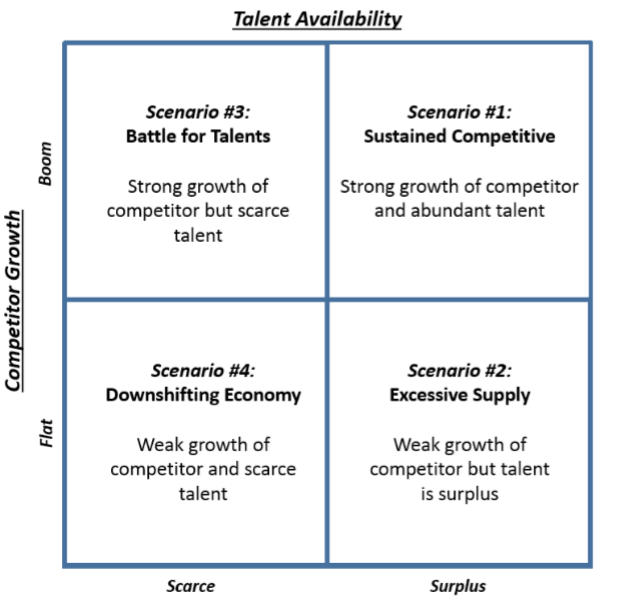
Consider if there’s a possible outcome that feels totally not captured by this chart. If so, that could represent a fifth scenario. - For each scenario, write a short narrative (1-3 paragraphs) describing the scene of how that situation came to be, and what it ended up looking like. This can include articulating reasons why each of the driving forces played out in the way that it did.
Assess if the scenarios are internally consistent—do the combined forces contradict each other. - Based on the scenarios, write for 5-15 minutes about what you learned. You might also want to write down some key questions that seem important to investigate sooner rather than later.
Further Resources
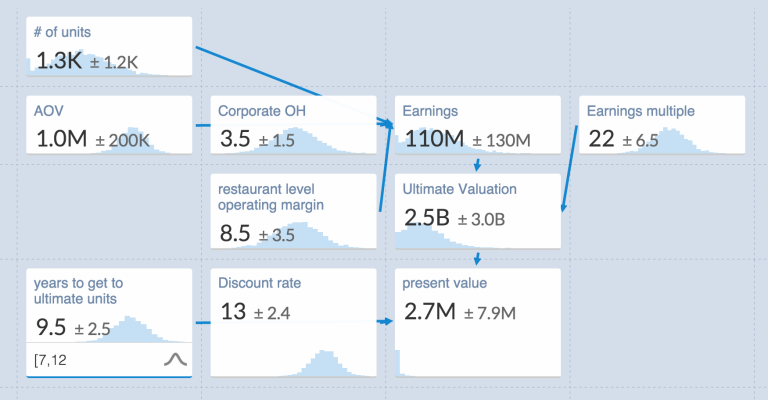
So far, this activity has involved describing potential scenarios with words. If your situation lends itself better to quantifying uncertainty with numbers, Guesstimate is a spreadsheet-based tool for putting uncertainty ranges on various variables, mapping out how they interact, and seeing how that might affect the values you’re interested in. It’s free to use the scratchpad or make public models, and has paid plans for private models.