Level up your Workflows – Build effective routines & habits

There’s a lot to choose from on this page! For now, just pick ONE to try out. You can always come back later to try others!

I want to organize my routines by spreadsheets!

Developed by Sebastian Marshall, Cycles is similar to the Pomodoro technique except that:

  1. Each work session is 30 minutes and each break is 10 minutes
  2. You reflect before and after each work session (you use part of your break time to do this) using a set of predefined questions
  3. You reflect at the very beginning of your work session and at the very end using some predefined questions  

Answering the questions helps you tune into exactly what you want to get done and why it is important to you.

You can use a Work Cycles Template for this exercise. First, make a copy, then feel free to adapt the language to fit what you want to use it for:
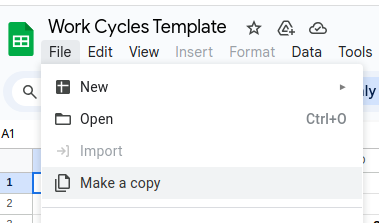
The process looks like this:

  1. Answer the Prepare questions
    (scroll down in the template to row 18)
  2. Answer the Plan questions for your first cycle
  3. Start a 30 minute timer and work on what you specified under Plan
  4. When the timer goes off start a 10 minute timer
  5. Answer the Review questions for your first cycle
  6. Take a short break
  7. Answer the Plan questions for your second cycle
  8. Once the 10 minute timer finishes, repeat steps 3 – 8 until you are finished working
  9. Answer the Debrief questions
    (scroll down in the template to row 27)

Resources

If there are things you want to do every day, you can do them more consistently and spend less energy on them by doing them at the same time every day.

A routine is essentially a sequences of these actions that happen in a regular order and/or time. It’s often effective to have more than one action in a routine because if you complete one you are likely to complete the other (i.e. a morning routine that includes making my bed, brushing teeth, some light stretching, meditation, breakfast).

It’s useful to track habit completion on a daily basis to increase accountability. See the Lights Spreadsheet below:

Resources:

  • Lights Spreadsheet (template 1, template 2)
    • This guide includes the excellent, seemingly counterintuitive, advice to “aim for 70%” completion of your habits, and adjust them to be easier or more difficult if you end under or over that mark!
    • Note: The Ultraworking site is unfortunately defunct, so please use the template links above instead of the ones in the guide.
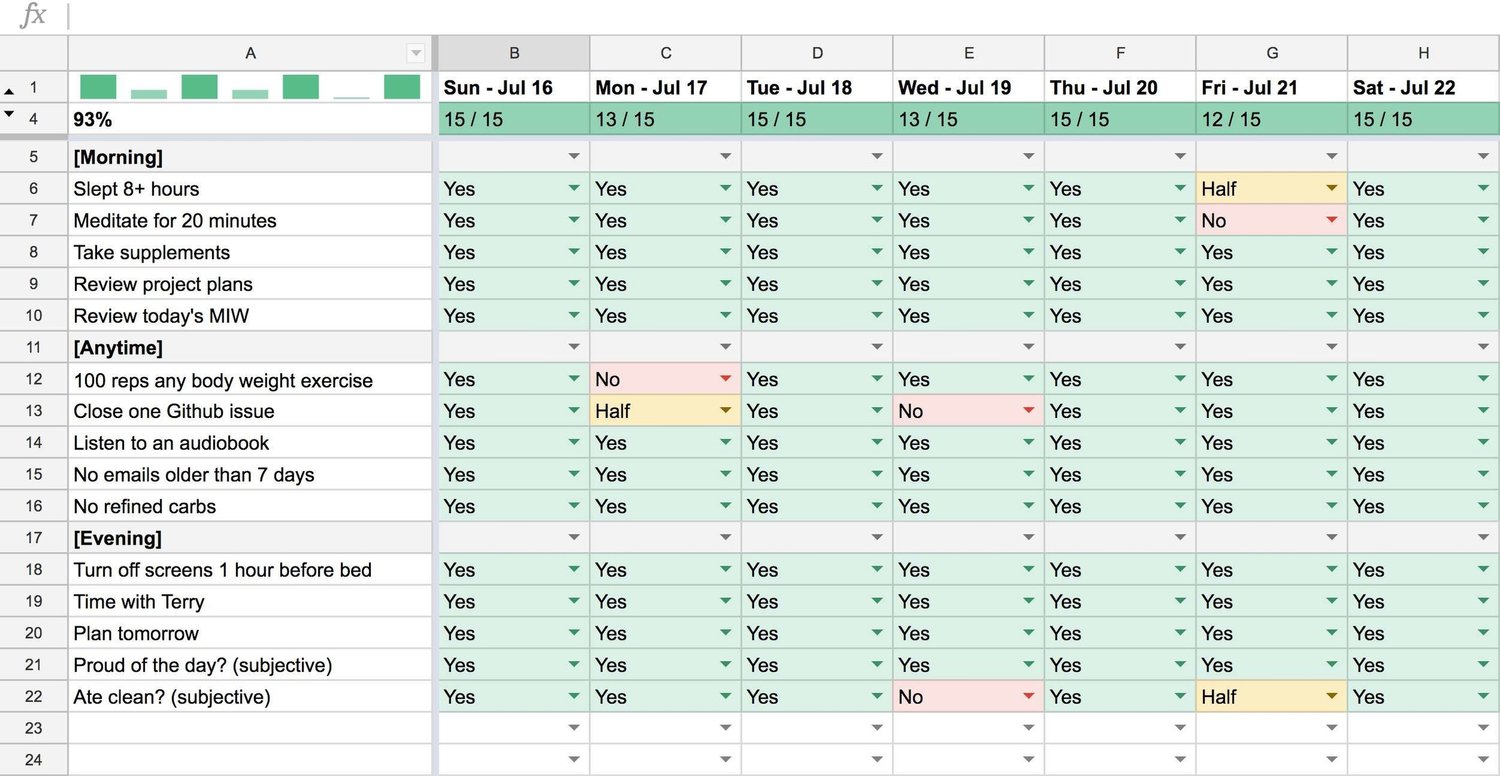
    • lights example.jpg
  • You can also add daily habits to Intend

Relevant blog post: “Habit Models: Routines vs Reflexes” 

I want small useful tools for Improving my Workflow

Specify before you start a work session what your intended output is. Be specific (what exactly will you have accomplished), and then write it down.

This is a simple way of increasing mindfulness and focus on the output which will increase quality.

This integrates very well with the next activity: “Make packets of work smaller“

This comes from agile and software development

Rather than investing a ton of energy into a single giant outcome, try to organize inputs such that you are creating more frequent smaller outputs that are of tangible value.

  • Example: Rather than spending a year working on your entire book, work each day on completing / driving towards the completion of a single paragraph/page.

Of course sometimes you will need to work on things in their entirety, but as a heuristic focusing on smaller work packets keeps you focused on frequent tangible outputs. By making the output tiny it also makes it easier to achieve, which can help you build momentum.

Before you start working on something, answer two questions:

  • How will I know when I have finished this task?
  • How long do I think it will take me to finish?

Track how long it actually takes you to finish.

This technique will help you:

  • To be motivated to complete your tasks in the amount of time you estimated, leading to higher focus
  • Increase your ability to predict how long things take you which is very useful for your ability to plan and schedule

If you want AI help in estimating time for your tasks, try the goblin.tools Estimator!

  1. Decide what you want to work on.
  2. Start a 25 minute timer.
  3. For the duration of the timer, don’t do anything that isn’t directed towards the thing you pre-specified. Don’t go to the bathroom, don’t go on Facebook, don’t question whether there is something more specific you could be doing.
  4. When the timer goes off, start a 5 minute timer.
  5. Have a break. Do anything except continuing to work on whatever you were focused on during your pomodoro
  6. When the timer goes off, repeat steps 1-6 four times.
  7. Once you have completed 4 Pomodoros, change your 5 minute break to a 20 minute break, and then repeat steps 1-7 as many times as you like.

Resources:
• Intend has a built-in Pomodoro timer
• TomatoTimer, a simple online Pomodoro timer

I want to change the flow of my work and play

Created by Cal Newport, the idea of Deep Work is basically the capacity to focus deeply, without interruption, on tasks that are very cognitively demanding. Many goals have components which require some degree of deep work.

Most people can only sustain a couple hours of high intensity focused work in a day. You will want to manage your energy and your environment to create a block of workspace where you can maintain focused attention while minimizing the potential for distraction.  

One approach you can take is to figure out what your most productive hours are:

  1. Try tracking for a couple days your energy level several times throughout the day and see if there are patterns.
  2. Reflect on when you usually do your most clear thinking.

Make it a habit to clear your schedule during that time, and use it to complete your most important / demanding tasks.

You can also create more blocks of uninterrupted focus time for deep work by setting aside certain days and times for meetings. Tools like Clockwise and Motion can help companies take this approach.

Mark Twain (probably never) said: “Eat a live frog first thing in the morning and nothing worse will happen to you the rest of the day.

That’s the idea behind the book Eat That Frog! by Brian Tracy: Start every day with your most important task.

Your most important task may also be somewhat aversive. Perhaps it’s a key email reply that feels “overdue,” or some necessary paperwork that’s been persistently sliding off your radar. Or, maybe it’s something you’re excited about, like finally shipping a feature, finishing a blog post, or starting an engaging project!

Either way, setting aside a specific time during your morning routine for these tasks:

  • Focuses your attention on the task when you’re most productive
  • Dispels any lingering “ugh” clouds that might otherwise plague your day
  • Keeps you on track towards your goals

You can apply this as a generalized strategy every day, or you can designate certain days of the week. (For example, if you have a morning class on M,W,F, you might do “Eat-That-Frog” on Tuesdays and Thursdays.) The key thing is to have a clear, unambiguous routine. (You can also deploy this technique occasionally for specific important actions that have been feeling stuck.)

Key steps to set up this system:

  • Decide on your most important task the night before
  • Specify how long you will work on it
    • For example: “a minimum of one Pomodoro“
  • Clear out a distraction-free path
    • Put your devices in airplane mode or turn off notifications
    • Make sure your computer will open up right to the page you need to get started
  • If you encounter a block, to the extent that any forward motion increases your resistance:

More tips:

  • You can also use this technique in combination with other systems, such as accountability partners or Beeminder
    • Check out the #mostimportanttask channel on the Goal-Crafters Slack for some social accountability! (Click here for more info.)
  • Remember to pick exciting important tasks as well, especially as you use this more often.
  • You can pair this exercise with Pareto Improvisation, to build self-trust both in your ability to complete important tasks *and* engage in deeply recharging activities

A common misconception: “So you start each day with your most dreaded task?”

The “Eat-That-Frog” approach does involve building the capacity to overcome initial aversion, like practicing stepping into a cold shower. However, it’s also key to make sure you’re doing the most important thing every day, not just the most dreaded.

For example, it wouldn’t make sense to prioritize scrubbing the super gross bathroom floor over a crucial and time-sensitive task that also happens to be fun and exciting!

More resources:

And remember: “There is never enough time to do everything, but there is always enough time to do the most important thing.” –Brian Tracy

Pareto Improvisation and Eat-that-frog (“do the most important task first”) are two different paths towards breaking the “Vicious Rock-Paper-Scissors” cycle.

In that cycle, there’s an uncomfortable but important task (like writing a paper). There’s a deeply recharging enjoyable option (whether that’s a good night’s sleep, an afternoon hike, or an evening with friends). And, there’s a short-term attractive but not nourishing option (“distractions” that avoid doing the uncomfortable thing but also don’t provide deep recharge).

Often, we don’t give ourselves “permission” to do the deeply recharging enjoyable thing, because we don’t trust that we’ll do the task that’s important for our long-term wellbeing, goals, and values. Eat-that-frog is all about building up the lived experience that you can and will do what matters most, through setting up streamlining systems and habits.

Pareto Improvisation is another part of the same system:

If I notice that I’m “distracting” myself in a way that doesn’t actually feel great, and there’s something different that all parts of me would rather be doing, I’ll do that instead.

Ways to implement Pareto Improvisation:

  • Sometimes, just making an agreement with yourself to notice and switch to what you deeply want, is enough!
  • Help with noticing:
    • Make a little sign for your work area, a paper sticky note or a note on your desktop
    • For sticky habits like internet “distractions,” you can track your noticing in something like a Captain’s Log, to help sort out any internal conflicts and brainstorm what you might rather do
    • Tech tools: Various apps and browser extensions can be set to send a soft reminder after a set period of time on Facebook, Reddit, Twitter, etc. Search for “website blocker” plus your browser or OS. For this, you don’t need a rock-solid app that is hard to uninstall. You’re not fighting yourself; it’s just a gentle nudge towards something more interesting.
  • Help with switching:
    • Create a list of activities that you tend to find deeply recharging, and add to it over time. When you notice that you’re doing something that’s not very nourishing, you can refer to the list and see if anything sparks your interest.

You know how sometimes you’re “working”, but you’re not doing important work, maybe just tweaking the formatting on something nobody will ever see?

Or alternatively, you’re watching some YouTube videos, but you are theoretically in the middle of a Pomodoro, so you’re trying not to notice that you’re watching YouTube videos, which means you’re also not noticing that the YouTube videos you’re watching are some random interviews with actors you don’t care about, as opposed to the new extended music video from your favorite artist that you’re super excited to watch full-screen and engagedly?

I speak from personal experience here, and I tend to feel kind of crazy when I’ve found myself in this sort of weird compromise, because no part of me is happy with what I’m doing.

Well, I have a really straightforward technique that helps achieve a bare minimum of sanity. It’s called Pareto Improvisation, and it’s loosely based on the concept of a “Pareto improvement”. A Pareto improvement is an improvement that improves something along one dimension while not making it worse along any other dimensions. So it’s an improvement that comes without any trade-offs or compromises.

Pareto Improvisation functions as a complementary path to the strategy of “do the most important thing”. It’s totally workable to have a single, scope-limited Most Important Task for the day – I’ve tried it, and I recommend it! But sometimes, people try and hold themselves to an unrealistic standard of “do the most important thing in each moment.” That can create a bunch of unwanted side effects if applied as a stand-alone strategy:

  1. It leads to second-guessing myself about what the most important thing is.
  2. It leads to self-deception because I can only do something if I convince myself it’s the most important thing.
  3. It leads to rebellion because parts of me don’t want to do the most important thing—they want to watch YouTube.

With Pareto Improvisation, you don’t need to second-guess yourself, because if even one part of you is like “I want to do this more than anything else” then fine! Do it. You also don’t need to deceive yourself.

And finally, it lets you honor all of your different desires, and not let them fight each other.

Pareto Improvisation doesn’t say, “Don’t do this distracting internet thing.” It says, “If you’re going to do it, you might as well do the most interesting version of it.” It allows your internal sense-making to navigate towards better options, without a need to figure out which option is best.

And you might sometimes find that you’re on Reddit, and none of you particularly wants to be on Reddit. You’d actually rather take a nap, or go for a walk, or even do some work, now that you’ve thought about it.

Seeking internal agreement is a great way to build an internal sense of same-sidedness, which means less resistance whatever you’re doing.

I like that it’s called “improvisation”, because it’s very much based on the idea that whatever your plans are, there are always going to be unexpected factors that will require you to improvise (i.e. make something up on the spot).

Create “if-then” statements for your goal. The scientific literature says these work very well.

Make sure the trigger and the action are both specific, such that there’s a clear moment to act and a clear action to take. “Before dinner” or “After I get home” are too vague. Make them “After I wash my hands before dinner” or “After I take my shoes off when I get home”.

Examples:

  • Goal: healthy eating  “If I have an urge to snack, I’ll eat some veggies before eating chocolate or chips”
  • Goal: travel to Germany  “If I’ve just gotten on the bus to go home from work, I’ll practice my German Duolingo for at least 10 minutes”
  • Goal: writing a novel  “if I realize I’ve been aimlessly scrolling down my newsfeed for awhile, then I’ll close it and do some writing.”
  • Goal: saving money  “if I’m out buying a meal, I’ll order water instead of a pricey drink.”
  • (more examples)

Further resources:

  • WOOP has instructional videos and an app to help set these plans
  • What are Trigger-Action Plans (TAPs)?” (by Lulie on LessWrong)
  • “Trigger-Action Plans” is the name CFAR uses for this technique, which is often called “implementation intentions” in the research literature